







Added Tuesday, February 21st, 2012 @ 9:59 PM
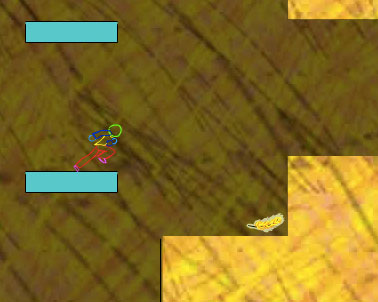
The goal of this project was to make a non-linear hypermedia piece. For this project, I wanted to try my hand at making a Flash game. 100 Needles is a Flash-based, side-scrolling platformer. Originally, I wanted the game to help players focus on a kind of non-linear/cyclical timeline in regards to the timeline of the game (as opposed to the real timeline of the players playing the game). For example, even though a person cannot come back to life in real life, the character in the game can be revived an infinite number of times. If the character dies, the game should end there, forever; however, he/she is brought back to the beginning of the level and is given a chance to try again. Also, the character never actually advances past the first level until a certain point is reached. Prior to that point, the character travels through the first level over and over and over again.
Unfortunately, the game doesn’t really present these ideas as well as I imagined it would. Regardless, it was my first Flash game, and I was pleased with how it came out!
CONTROLS: Use the arrow keys to move and the spacebar to jump.
Here is the original assignment:
Your second project will begin to experiment with the non-linear characteristics of hypermedia. Again, the subject matter and its development will be determined through a process of proposal and preliminary review. In this exercise, you will be encouraged to investigate the structure of communication from the point-of-view of the “reader” as opposed to solely the “author.”
Added Tuesday, February 21st, 2012 @ 9:56 PM
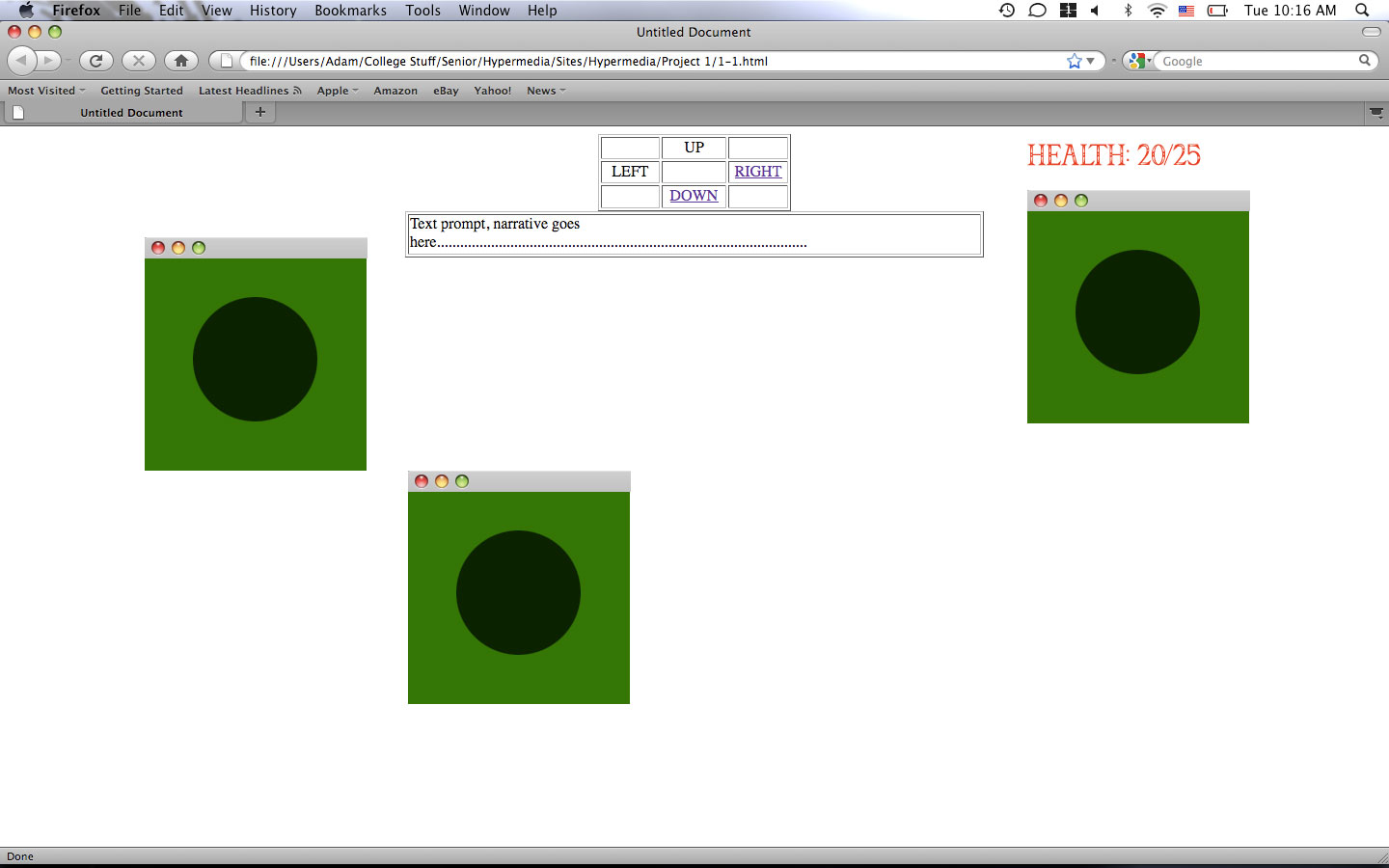
The goal of this project was to create a narrative hypermedia piece. I decided to make a sort of choose your own adventure game based on a series of linked web pages. They all follow the same basic story, however, depending on the choices you make (the links you decide to click on), the story can end in different ways. Also, the game is designed to only let you play it once. This way you can’t change your mind about a decision, so choose carefully! (As browsers have advanced, there are ways to play it more than once, but play it as though you can only play it once :P)
Some of the images below have spoilers, so I recommend playing the game before you view any of the images.
Here is the original project assignment:
The first project will build on our class discussions regarding narrative and linking structures. Culled from your own personal interests, you will brainstorm ideas for a hypermedia artwork that follows narrative form. Your ideas will be submitted in the form of a proposal, will undergo preliminary critique, and finally be developed into a completed work. Your project will be evaluated on its technical merits as well as its ability to communicate meaning beyond the simple story.
And here is my original proposal:
Project 1 Proposal
Materials:
-Adobe Creative Suite Programs:
==Dreamweaver, Photoshop, Illustrator, Flash
-Sound Editing Programs:
==Audacity, GarageBandLocation:
As this project will not be usable more than once on any one computer, I hope to show this project in the FAC 306 computer lab so that all students are able to experience the project individually via the different computers in the lab.
Project Explanation:
As of now, I am planning on making a type of online text-based game that will incorporate multiple web pages with descriptive and navigational text and possibly the use of visual cues and/or images. Internet browser pop-ups will also be used, possibly along with sound clips/music.
This game will be based around user interactivity dependent upon written/visual cues via the Internet browser. There will be an ongoing multi-branched narrative (the “story” of the game) that will change dependent on the user’s interaction. The ways the user will interact will be by navigating through a virtual maze via directional hyperlinks (Up, Down, Left, and Right) that are displayed on every page in this project. By using the navigation links, the user will direct himself or herself through this virtual maze. The object will be to reach the end of the maze, at which point, the player wins. In certain “rooms” (rooms are the equivalent of the different web pages) the user will come in contact with monsters, represented by pop-ups that will appear above the original page of the browser. In order to “defeat” these monsters, the user must click the pop-ups a certain number of times, at which point the pop-up will disappear, simulating the defeat of the monster; the user will then be able to continue navigating through the maze with the directional hyperlinks. While the pop-ups are visible (the monsters have not been defeated yet), the user will slowly lose health (which will be a visible meter on the original page). If at any point, the user runs out of health, the game will end. Unlike other games, however, once the player has run out of health, the game cannot be restarted. As of now, I plan on using an IP block to prevent the same computer from playing the game more than once. IP blocks, however, can be worked around, so I am looking into additional methods to stop a computer from playing the game more than once. So, simply put, if one dies in the game, it is truly “Game Over.”
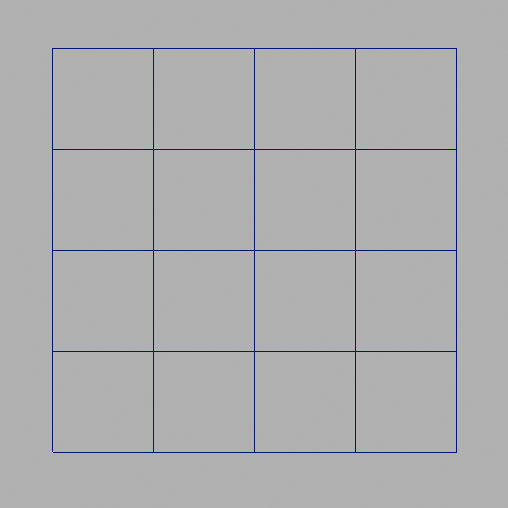
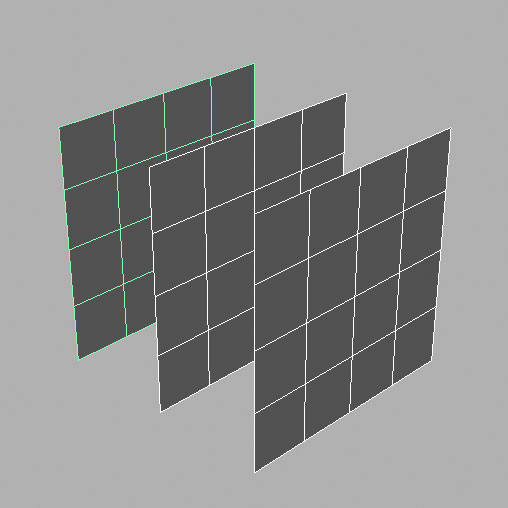
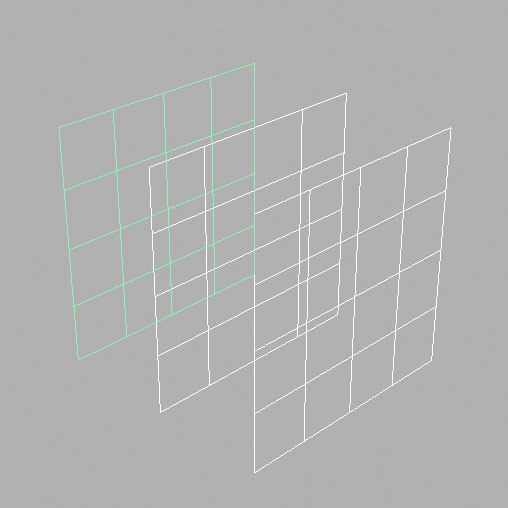
The maze will be two-dimensional in layout (for example a 4×4 grid comprised of sixteen squares). The user will start in one square and will have to navigate through the grid in order to get to the end (a predetermined square in the grid). However, there will be multiple grids that will be “layered” on top of each other, creating a three-dimensional grid that is comprised of multiple two-dimensional grids. These different layers will not necessarily be used or seen in a play through of the game; it is all dependent on the user’s input. These layers will be used if the user makes certain decisions based on the on-screen text prompts. They are essentially the different paths that the story will follow. For example, the user is notified by the on-screen text that there is a stairway going down on the square that the user is currently occupying. If the user does not use the stairway, the grid will stay the same, but if the user chooses to go down the stairs, the grid “below” the current grid will be used. This grid will be different from the ne “above” it in that the boundaries will be different, the squares that monsters occupy will be different, and many other things will change. This decision can potentially change the outcome of the game. It will be possible for the user to navigate through only one grid before winning the game, according to the choices the user makes, multiple grids could be used. The grid changes will be completely unnoticed by the user unless tied to the story somehow (as going down the stairs probably would be).
Concept:
There are multiple conceptual aspects to this game, the first of which being that the game explores the fundamental purpose of hyperlinks –navigation. What better to do so than actual directional keywords that move one through an array of related web pages? Quite literally, the user will explore the purpose and applied use of hyperlinks by navigating through the Internet.
The design of each page will be simple in design, and will convey a sense of easy navigation through these pages. However, with the use of the text prompts and user input, navigation will become harder than perhaps originally anticipated. By using simple and easy navigable hyperlinks along with the complexity found through the user input, I hope to arouse thought of both the simplicity and convenience as well as the sheer and utter complexity of the Internet.
Through the use of pop-ups as “monsters” I will be exploring the widespread thought behind pop-ups –they are bad and must be stopped. Often, one must click multiple times in order to get rid of one pop-up; additionally, some pop-ups actually are harmful to the computer (may contain viruses and such) as will be exemplified by the player losing health.
The concept of the “maze” and the user’s exploration of it is related to the way a user of the Internet “searches” for something or “navigates” through web pages. Also related to this is the fact that the user may “die” in the game and become banned from retrying. Many times, one will find what he or she is looking for with the help of the Internet, but there are other times when the desired outcome does not occur and the user simply gives up on trying to find what he or she is trying to locate. Perhaps the reason is broken links, unexpected interruptions, or it is simply not there, all of which are to be imitated by in-game features. Will the user find the end of what he or she is looking for –the end of the maze that is the Internet?

Added Tuesday, February 21st, 2012 @ 9:54 PM
If I remember correctly, the assignment for this project was to make a piece of “wearable technology.”
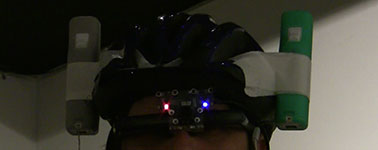
Though not by name, AU is a spiritual piece of the WiiMersioN Project. My goal was to create a device that would allow a user to view a 3D environment using his/her head movement to change the direction of the virtual camera. Essentially, I wanted to make a virtual reality helmet, and that’s pretty much exactly what I did :D. Using two Wii remotes, a bike helmet, Unity, a pair of VR glasses (glasses with little screens in them) that I borrowed from a friend, lots of math, and good ole fashioned duct tape, I created a device that allows users to immerse themselves in a virtual world.
Aside from the plugin that allows Unity to communicate with the Wiimotes, I created everything. I think… I can’t remember if I modeled the 3D room or not. I certainly have modeled that room for other projects, but for this one I may have used a preexisting model that another student made…
Added Tuesday, February 21st, 2012 @ 9:52 PM
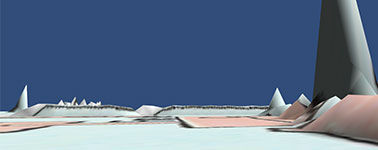
If I remember correctly, this project had to do with local locations. We were supposed to make something that had to do with sites and/or areas that were local to use and that we inhabited or visited often. I chose to base my piece off of UF’s campus and surrounding areas since that’s where I spent the majority of my time. I ended up making a game with Unity. The ground is textured with a map of the university. The game starts you off at the location of the apartment complex I was living in at the time, The Courtyards, which is literally across the street from campus. You are then free to roam around the “campus” as you please. In order to visually mark the areas that you visit/inhabit most often, the elevation of the ground near you continually rises.
Controls: Move/walk with WASD and/or arrow keys, jump with space, look around with the mouse, and switch to an overhead view of the map with enter (switch back to first-person by pressing enter again).
Here are my original ideas for this project:
For this project, I went through quite a few different ideas over the course of the few weeks.
Idea 1
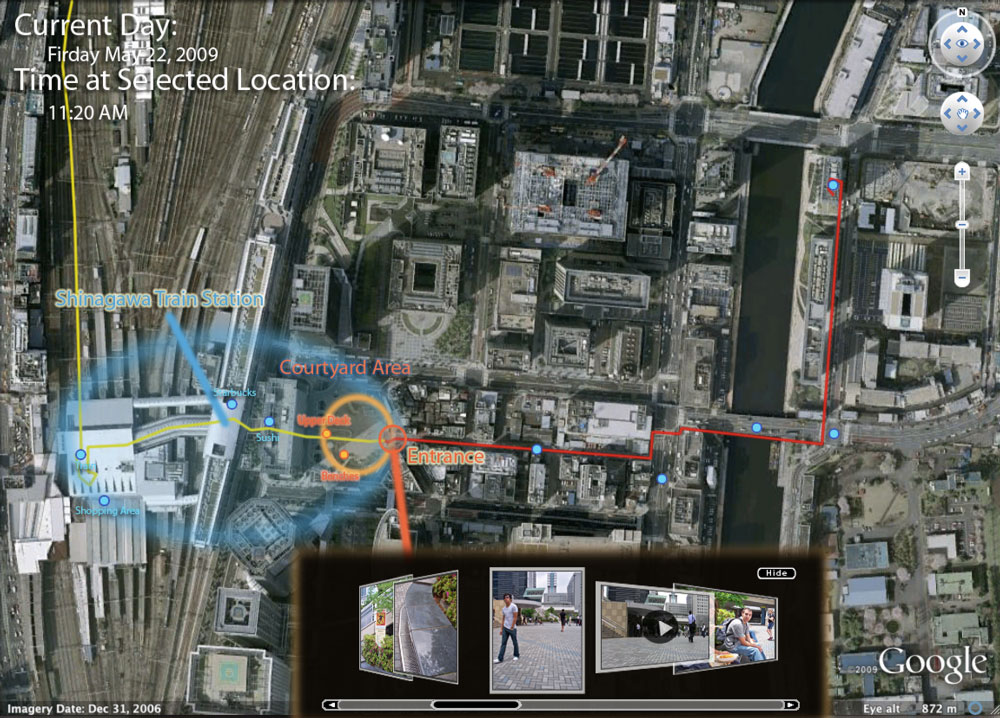
The very first idea I had was to do something with the thousands of pictures and video footage I have from Japan. While these things are not local in respect to my current whereabouts, there were five weeks over the summer in which these areas were very much my local; it will hopefully become my local again sometime in the future as I plan to go back and possibly live there. My original thought was to basically recreate my experience in Japan by means of putting together what I would consider a virtual memory (hopefully I can make this term become more clear in its definition). I wanted to piece together all of the photos and video I have in chronological order. The result would be the visualization of images and video in the order they were taken, which, in turn, would take the viewer through a virtual experience identical to mine in Japan. For example, we first arrived in Narita airport (the viewer would see hundreds of images/videos; enough so to hopefully allow the viewer to create a mental space for this place they’ve never visited.
Imagine, if you will, if it were possible for someone to record exactly what they see, from their eyes. Unlike a video camera, this video would not be from an external device, held out at an arm’s length, constantly bouncing around due to arm/hand instability; this video would be from the person’s eyes. Whatever the person were to look at, the video would see; anything that’s out of the person’s field of focus would be blurry, anything that’s out of the field of view would be unseen. For all intents and purposes, the viewer would be looking out of the “cameraman’s” eyes. Now what if there were no limit to the amount of video recorded? What if a person could record their entire life that could be later viewed by the individual as well as others? If this technology existed, how would (if at all) this change experiences? For example, would watching a recording of someone who visited Japan be the same as going there in person? If the experience is so complete, how would it be any different?
This technology wouldn’t be true virtual reality, but it would certainly be very close. While there is no tactile responses from this recorded footage, it would be insurmountably more complete an experience than simply looking at a few snapshots and some videos from a selection of a dozen or so.
Obviously, the idea for this project has some flaws (it is NOT this technology, it is NOT a complete visual experience of my trip, etc.), but it is working towards it. This is the kind of thing I was thinking about when I wanted to do this idea. That being said, I did take tens of thousands of pictures and hundreds of videos –waaaaaaay more visual record than any other person would take over a five week period; I believe this huge amount of data I have would be a very complete experience of my trip, and I thought about that while taking the pictures/videos –I wanted to capture everything, even if it wasn’t or didn’t seem important –I wanted every experience recorded.
Often people (usually tourists) who do nothing but take pictures are made fun of or pitied because they are experiencing everything through a camera. The point (or at least the supposed point) of going somewhere different is to experience that place first-hand, yet how can one do that while constantly looking through a camera lens? The camera-person is more fixated on getting things in the frame, stopping to pose, or thinking about what to take pictures of than actually experiencing the place. Also common in this kind of discussion is the notion of authenticity. The only way to have something be “authentic” is to experience it first hand –to see it with his or her own eyes and remember the experience by pure memory alone. These experiences become tainted, sometimes even skewed and distorted thanks to the aid of things like photos and videos. You may remember something different than the way it actually happened, you may notice something later that you didn’t notice the first time. These things may distort your original experience –perhaps in good ways, perhaps in bad; regardless, the distortion is still occurring, which, many would say, detracts from the authenticity of the original experience. With that said, the person who is constantly taking photos is missing out on these original, authentic experiences in order to relive them later in a (usually unknowingly) less authentic and certainly less real way.
I’m not saying I didn’t succumb to this, but what I will say is that I was completely aware of it. I KNEW I was taking a lot of photos, I KNEW I was missing out on some authentic experiences, I KNEW reliving the experiences through photo would not be the same as experiencing them in the now. Because I was aware of this, I protected myself from it (or at least constantly tried to). What I mean is that many (many, many) of my photos and videos are shot without my even looking at the camera; I was looking at these things with my own two eyes but at the same time, aiming the camera at it, snapping a shot, and hoping for the best. Obviously many of the photos didn’t turn out ideal, but I did get quite good at getting the photo I wanted. By these means, I was almost using this imaginary technology mentioned above –I was recording my experiences very fully, but I was doing so without losing the chance to experience the authentic (as would be the result of a constant video feed from one’s eyes). Defending myself is aside the point. What IS the point is that I knew what I was doing in anticipation of creating a very full experience for both myself and others by means of a project like this.
Onto the project itself. In short, it would create a very full experience of my trip –ideally enough so that the viewer would feel as if he or she had gone on the trip in place of me. What I would do would be something like this: I would collect all of my photos, videos, and collected objects (brochures, magazines, newspapers, random small objects, etc.) and organize them chronologically. In addition to doing this, I would map where each photo, video, etc. was taken to create a visual path on a map (the first batch of images where from Narita airport, the next from the train, the next from the train station, the next from another train, the next from the Shinagawa train station, the next from the road to our hotel, etc., etc.)
Idea 2
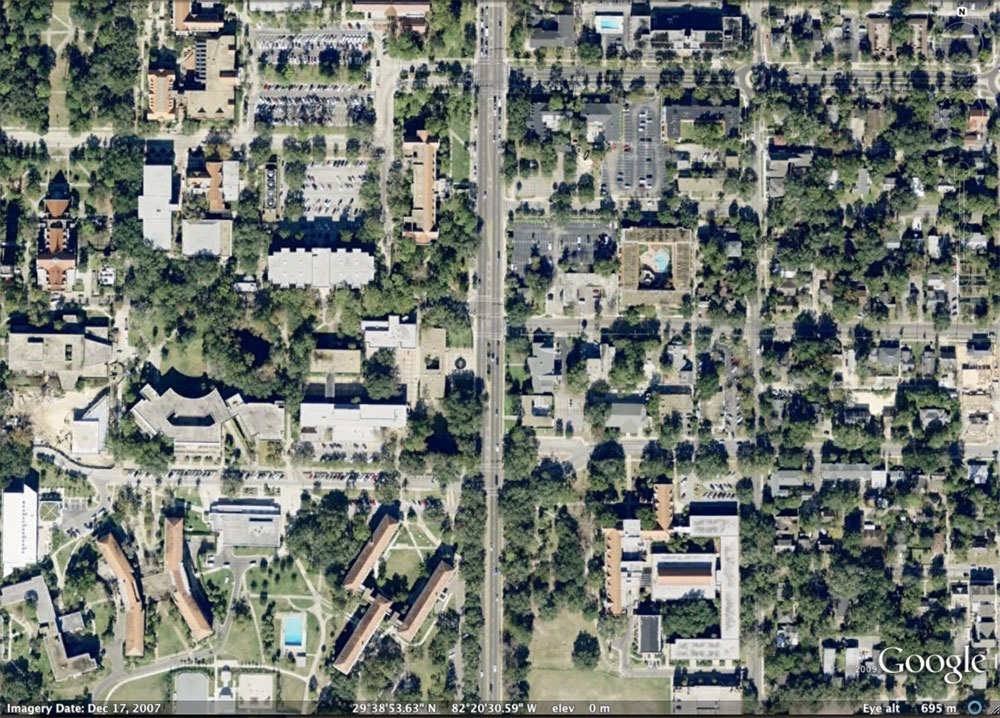
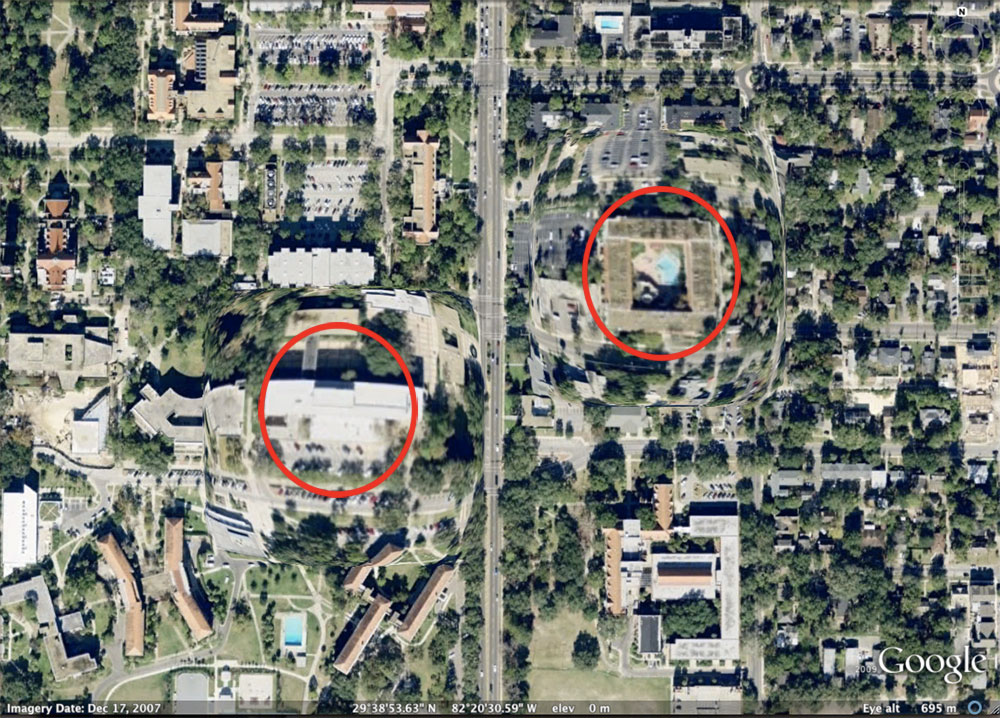
My second idea had to do with a locale much closer to home. In short, what I would do for this was map my individual paths throughout the course of the weeks before the crit via GPS. Visually, I had imagined it to look like what Katie’s project turned out to be. However, I did not plan on having a static image. This would be something interactive. The viewer would be able to toggle different paths on and off (to view all, some, or just one at any one time). These paths would also hold information about what activities I was doing while inhabiting these different areas (personal activities, schoolwork, relaxing, sleeping, eating, walking, driving, etc.). The different activities would be denoted by different colors. In addition to this, I had planned on deforming a map of the area in accordance with my GPS findings. The longer I was in a certain area, the more deformed that area would become. I had thought about two different ways to deform –locally and globally. The former basically meaning that the deformed areas would appear bigger but would not take up more than their original space on the map. The latter meaning that the deformations would bleed into adjacent areas. Here are examples of each – original, local deformation, and global deformation:
I thought this project would be interesting for a few reasons, one being I’m curious to see how exactly I spend my days. I consider myself somewhat unusual in that I hardly ever go out anywhere. This is especially true this semester as myself as well as all of my friends are constantly busy and hardly have time to hang out. The vast majority of my time is spent either in my room or in FAC 302 (I have all of my non-online classes in this room this semester). Over the course of the three and a half years I’ve been here at UF, I have easily spent the most time in either FAC or my room (Jennings Hall for two years and the Courtyards apartment complex for the last year and a half). How long exactly do I spend in these places? How long is it compared to other places I visit throughout my days here? Where all do I go other than my apartment or FAC? How many times have I gone over the exact same path to get from one place to another? How many times have I stepped on the mulch surrounding the Courtyards’ plants? How many times did I ride over the on Jennings’ lawn? How many times have I traveled up and down the west staircase of FAC? Have I created some kind of path over the years? Have I affected the ground over which I tread at all? If so, how?
I’m also interested to see how much time I spend doing certain activities. Time and time again, I find myself working on projects for hours on end. An entire day goes by without me even realizing it. The same often happens when I play games or read books that I really enjoy. Time just completely escapes me. I’m really eager to see what those numbers would be as well as those indicating how long I spend in a certain place. People say that humans sleep one third of their life away. I think it’d be neat compare that to my sleep cycle. Regardless, I think people (myself included) would be surprised by the results that arose from this project.


Added Tuesday, February 21st, 2012 @ 9:50 PM
The objective of this project was to create a “spacial sound” piece. For this project, I wanted to try to capture the essence of a physical location with sound.
To begin, I found images of large U.S. city’s cityscapes, specifically Chicago, Houston, Los Angeles, and New York. I wanted to create (sound) waveforms that matched the shape (or rather the outlines) of the cityscapes. I was able to do this with the help of a program called MetaSynth and sidewalk chalk. As you can see in the images below, I projected the cityscape images onto a wall. I then drew outlines of the cityscapes with chalk on the wall. Next, I projected MetaSynth over the chalk outlines and recreated the outline as a waveform (actually, judging from the images, I think I may have been manipulating the frequency of a pitch over time rather than the waveform itself). Finally, I took the resulting audio, and made a small Flash app that plays the audio from the corresponding city when you click different cardinal directions on the onscreen compass.
CONTROLS: Click the cardinal directions on the compass to view/listen to a different city.
Here’s the original project assignment:
PROJECT ONE
Spatial soundCONCEPTUAL OBJECTIVE
In this project you will use sound to create a 3-dimensional space. You choose the content and the technique or strategy of what you will put in the sound space. There are many ways to do this. The most obvious is to build a physical installation or sculpture where the interaction between the audience and the sound creates an environment. But, the space can be virtual and the experience could be one of headphones and the screen or even headphones and the environment ala Janet Cardiff. The main objective here is to use sound to transform a perceived physical space into a place that is sonically reflective of the content or message of your piece. What I do not want in this project is a soundtrack for a video or a composition/song. There needs to be an element of interaction and participation on the part of the audienceTECHNICAL OBJECTIVES
- Use various audio software to synthesize and transform sound.
- Experiment with various pieces of hardware such as speakers and microphones and their placement in space.
- Cultivate a DIY approach to digital art making. (What can I make from what is around me and easily available.)
FORMAT
You determine the final format of this project. Part of the objective of this project is to take an idea and vision and work with it over time. The preparation is as important as the product. Writing reflectively on the blog about your process, how your ideas evolve, and document the research you do to as you create your piece as well as evidence of experimentation of the sound media that you choose plays an important role in my evaluation of this project. At the critique, you must not only turn in the documentation of your final product in the form of a DVD or CD, but also include the supporting files of the material that you worked with to get to the end product. You have about a month to complete this project. During this time, I need to see your process. You should expect to receive feedback both from the class and myself as you work on your sound piece. If any one has questions on what I am asking for, please do not hesitate to contact me.MATERIALS AND SUPPLIES
During this month I will provide opportunities for you to experiment and play with various types of audio components. With respect to your own pieces, you will most likely need to purchase some equipment.Look around town in thrift stores, pawn shops. Browse Radio Shack (I prefer the one on Main in terms of customer service and knowledgeable staff.), Best Buy, and Circuit City.
Two good sources that are out of town are
American Scientific Surplus
http://www.sciplus.com/Skycraft Parts and Surplus
http://www.skycraftsurplus.com/WAYS TO APPROACH THIS PROJECT
Look ahead in the syllabus at the artist links to get ideas about what you might want to do. Think about situations where sound has greatly impacted you or sonic events that were transformative to you. I will expect that during the next month you will have various prototypes or experimental evidence to show the class and myself along the way.
Added Tuesday, February 21st, 2012 @ 9:41 PM
I was very pleased with how this project turned out. The assignment itself was simple enough. We just needed to author a DVD of the three video art projects we did that semester. I, however, decided to make the DVD a piece of its own.
Because the medium of this project was the DVD itself, I’m not able to show it online.
Added 2/21/12 @ 9:40 PM
The goal for this project was to create some sort of video installation. I forget exactly where the idea came from, but I basically created a pair of box forts that viewers could crawl into. At the end of each fort there was a screen. Projected onto the screens was LittleBigPlanet. The intent was to allow viewers to create levels in LittleBigPlanet based off of childhood memories of theirs. Because any levels made were saved, visitors could also play through levels (memories) that previous visitors had made. Prior to presenting the project, I created three levels representing three childhood memories of my friends (I had asked friends of mine to send me childhood memories during the process of making the project).
So between the box forts, crawling, displaying childhood memories in a visually “childish” video game, and the opportunity to create whatever the mind came up with, I wanted the installation to encourage a feeling of childhood and, to an extent, nostalgia for one’s childhood. The videos from LittleBigPlanet you’ll find below are the three levels that I made in the game.

Added 2/21/12 @ 9:37 PM
If I remember correctly, the assignment for this project was to record some kind of “performance.” I also think audio was supposed to be a technical point of focus. Regardless, I can tell you what I did. For this project, I sat down with a bunch of my friends and played video games. It was awesome. Aside from that though, we talked about different gaming-related memories we had while we were playing. I wanted to try to achieve a stream of consciousness-type conversation about these memories. Often times, when people are playing games (especially when they’re really focused on it), it’s hard to multitask, in this case it was hard to game and have a conversation at the same time. I wanted to conversation to both flow naturally from one topic to another as well as have random interjections reacting to what was happening onscreen while we were playing.
Originally, I wanted us to play (and have me record us playing) a bunch of different games. However, due to technical difficulties (incompatible TVs, video cameras, and cables…), our options became limited. I decided that we should just play Ocarina of Time, since that was a game that we had all played extensively, but we could still talk about other games. In the video, only one of my friends is actually playing OoT while the rest of us are watching. I decided to do this because he had always had an extremely difficult time with the part of the game he was at (he may have never even gotten past it previously, I don’t remember…), so I figured this would allow him to concentrate on the game as well as allow the rest of us chances to help advise him along the way (playing into the interjections I wanted to have present).
So, in addition to the video footage of Ocarina of Time and the audio of our conversation, I also included text at the bottom of the screen. If I remember correctly, this was in response to a suggestion (I suppose from my teacher) to include some sort of way for non-gaming savvy viewers to follow the video’s conversation. The text gives general facts about the games being talked about as well as clues as to why specific moments or games are so memorable to my friends and me.
I don’t remember when exactly during the process of making this project I wrote this (obviously it’s before I started shooting), but here’s one of my original descriptions of my idea:
So what I’ve done is I’ve asked a lot of my friends to describe to me personally important moments in gaming for them. Some of them have been moments that are narrative-based, some are accomplishment-based, some are relationship-based (both with characters and real people). I’ve got a few different ideas of what I could do with these. My original idea was to have gameplay footage of a game playing as the video while my friends and I play it (I’m not sure how many of us would be playing at the same time; it could be just one friend and myself, three friends and myself, or maybe some aren’t playing the game, but they’re still part of the audio), and we talk about these different experiences in a stream-of-consciousness manner. So, for example, we start talking we’re playing Super Smash Brothers Brawl, a Wii game, and one of us chooses Pikachu as a character. Because of this, we start talking about our memories of the Pokemon games (it’s addictiveness, how it was somewhat of a fad in middle school, how it felt like such an accomplishment to reach the final bosses after so tens/hundreds of hours of play), then perhaps from there we move onto Ninja Gaiden, an Xbox game, and we talk about how incredibly difficult that game was, how it brought out the worst in us because it was so frustratingly difficult, yet we kept on playing it, etc, etc.
Now, on thinking about this, I wasn’t sure if I would change the video game being shown on screen. For example, I thought about showing the games that we’re talking about. But that kind of disrupts the sitting down, just talking stream-of-consciousness feel that I’d like to be present. If just one game is being shown (a game that we’re playing while talking), I think it would feel more real as an actual conversation.
I also thought that perhaps during this conversation, we could decide to play another game. For example, we’re talking and playing Super Smash Bros., then after a few matches we decide to pop in another game (the video would show this process as seen by the TV, so you’d see us go back to the system menu, eject the disc, put in another disc, and start the new game). Or perhaps a one of our cell phones ring and it’s another friend who wants to play an online game with us, say for example Halo 3. I kind of like this idea of playing the game with someone else in the room as well as someone online. In most online games, you can talk to other players with headphones. I’d be able to get the audio from the online friend as well and use that in the conversation too. So say, we end up playing Halo 3 with a friend online. We say hi, and then tell him what we were just talking about. This new person is then a third member of this stream-of-consciousness conversation.
So those were some ideas about dealing with changing video (if, in the end, it does change).
Another idea for dealing with these responses I’ve got is to do (in my mind) something similar to Waking Life. I would have each person who’s given me a response explain these responses to me in person while I recorded them. So I could go about this a few different ways. I could have the person sit down and have the camera focused on them while they talked about these experiences they’ve had, cutting to another person when the previous one finishes their thoughts. I could do this same thing, but show the gameplay from the game that that person is talking about (could be any gameplay or I could have them play the game while they talk about it). For a lot of these responses, I’ve been asking questions during these conversations such as, “Why was that your favorite part?” or, “Did you feel this with any other game?” for example. So I could do sit down and interview-type video where it would show either just the person (I would be behind the camera) or show both of us while we discussed these memories. Or I could do it by showing the video game gameplay while we talk.
With this, I would go from individual to individual talking with them/recording them talking about their memories.
I could also include some of the conversations I’ve had online, for example, one was over iChat. So my friend and I could, in essence, reenact the conversation while I recorded the screen. The audio here I think would be just the sounds of the computer (typing, message sent sound, message received sound, etc.).
*(or video chat)*
I’m very interested in these memories because they’ve affected these people personally in many different ways. While I was talking to one of my friends, he pointed out that these kinds of reactions can be seen in many other types of media (film, novel, music), so why talk about video games? I think that many times, video games are overlooked as just a niche culture that doesn’t mean much to culture or society as a whole. Thinking this way, many people would be surprised as to the extent that people can/have been moved by games (the same extent as the other media types can move someone, perhaps moreso). And so I’m very interested in this personal connection/affection people can form with games, whether they be connections with characters, a personal realization that a game has taken over your life, the feeling like you’re part of something bigger than yourself, etc.
Personally, I’m more drawn to the first idea I gave (about sitting down and playing games while we talk about these things) because of its nonchalant, unrehearsed, every day conversational feel. I also think that this kind of situation (playing a game, only half paying attention to what’s going on around you) is prime for a stream of consciousness conversation. I’d like to add that while this conversation is going on, we would also be reacting to the game; so for example, if one of us dies, we would say, “DAMMIT!” or some kind of natural response that would be present as if we were not being filmed. I think this as well adds to the everyday feel.

Added 2/21/12 @ 9:32 PM
The objective of this project was to record a process of some sort. Also, I believe we were supposed to have at least one cut from one angle to another showing a continuous action. For example, at one point in the movie, I start to open a drawer with the camera behind me, then it cuts to a camera inside the drawer as I open it. I chose to record myself packing up my things in anticipation of going home (for the weekend or a holiday or something). The thing you should know is that, at the time, I would pack up and bring home practically everything in my room, so the whole ordeal would take more than an hour. Originally, I wanted to have the movie be an hour (or however long it actually took me to pack), but it was suggested that I cut it down for the sake of time.
Added 2/21/12 @ 9:30 PM
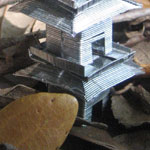
The goal of this project was to have students build some kind of tower out of metal. Like the previous Metal Wall project, I decided to go a slightly different route. My original plan, however, was to make a giant, metal tower, or rather, a series of giant metal towers. I wanted to build a system of giant chimes arranged in a circle. As you can see in the images below, the chimes would be arranged in a circle, and the viewer would be able to walk into the middle of the chimes if he or she chose. Upon hitting the giant tubes (with some kind of mallet perhaps), they would emit musical notes just like a set of percussive chimes. If I remember correctly, the smaller the tube, the higher the tone (or maybe it was the other way around…). Here is my original proposal for this idea:
For this project, I would like to create a series of tubes that are set up in a circular layout. These tubes would be (ideally) taller than the viewer and would form a large structure that the viewer(s) could walk into via a section of this circle that is not housing a tube. The tubes would be arranged so that the edges of one tube touch the edges of the next tube. Each tube would be higher than the next. I would like this piece to resemble a wind chime. Although I am not yet sure if I want to (or if it would be a good idea/work) put a piece in the inside of the ring of tubes that reacts to the wind. The reason I am unsure about this is because the piece would have to be relatively big in order to cause a sound when it hit the tubes, and it would also have to hang from the top of the piece that would block the view of one looking up while inside the piece. I also thought about hanging the entire piece, but I decided against it for much the same reason (also, I’d imagine the piece will be heavy and hard to support from a hanging structure). I would like these tubes to produce sound, however, so I have thought about giving the viewer(s) a mallet or some type of tool to hit the tubes and produce different sounds. I would like there to be eight tubes that each produce a pitch from one octave (eight notes in an octave; eight tubes to produce each note). I can see a few things that this piece could mean. It could have something to do with the “power” of music, both audibly (since the sound produced will most likely be quite loud) and physically (again, the soundwaves produced by the tubes will most likely be felt physically). This could also talk about the power man has to control his environment or the power to manipulate the things around him (manipulating sound or manipulating the tower as a whole to do what he wants).
Unfortunately, upon discovering the price such a magnificent piece would cost, I immediately set my sights on building a smaller tower. And build a smaller tower I most certainly did!
“Instead of building a giant tower that’s much bigger than a person,” I thought, “why not build a tower that’s much smaller than a person?” I decided to build a “mini” tower, if you will. Here is my original proposal for that idea:
What is a tower? Is it something big? How big? Bigger than humans? As big as a skyscraper? Does it have to be that big? Is a two-story house a tower? Is a one-story house? It’s bigger than us, so why not? Has the definition for a tower changed over time? Why do we consider some things towers and others not? Are humans themselves not towers to smaller animals or even to each other? To something like a gnat, humans are outrageously colossal. Even just a finger nail or a hair is many times bigger than the gnat. Imagine being the size of a gnat and seeing something as big as a human. Would that be a tower? In this project, I plan to make a small (relatively speaking) metal structure, no more than six inches tall. The shape of this metal structure will be influenced by old Asian (mainly Japanese and Chinese) architecture, specifically pagodas. The reasoning behind this is twofold: one, a pagoda was the first shape that I thought of when I thought of a tower, and two, because pagodas were some of the first “towers” being traced as far back as the 3rd century BCE. In order to give the viewer(s) some point of proportional reference, I am going to make this tower out of staples. This of course, won’t be any specific proportional reference, but rather it will be a general reference to let the viewer(s) know this tower is working within the confines of the mini. In order to attach the staples to each other, I will use some kind of transparent glue. I’ll start by seeing how well hot glue and a hot glue gun will work, however I can see a few problems with this, so in case that will not work, I have other glue that I can use in combination with a small nozzle so as to make the gluing as unnoticeable and exact as I can.
So, I ended up building a tiny tower out of staples! For the critique, I placed the tower in the art department courtyard next to some small palmetto trees (there is also a much larger tree in the patch, but it is not in any of the photos). I thought it was really neat that even the leaves were bigger than the tower.
Note: The character model in the 3D renders was not made by me. It is the Zero Suit Samus model from Super Smash Bros. Brawl. I used it for size comparison.
Added 2/21/12 @ 9:27 PM
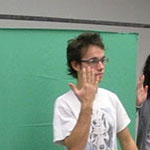
This project for my metal working class, as the title implies, was to build some kind of wall out of metal. I took a somewhat less literal approach. I welded pieces of metal together to build a large metal frame to hold a green screen. I also used metal wire to tie the green cloth to the frame. For the critique, I aimed my camera (which was hooked up to my computer) at the green screen and projected different walls on the… well on the room’s wall. As students stood in front of the green screen “wall,” they would find themselves standing in front of famous walls such as the Great Wall of China, the Berlin Wall, and the Vietnam Memorial. I had created a physical wall that virtually transported those in front of it to other physical walls around the world! This, of course, is done nearly everyday on the news and such, but it’s still a pretty neat concept to think about 😛